
Do so using technology at reduced cost to the NHS
Tonsmor Doctors has the knowledge to advance the design of technology to deliver healthcare free at the point of care to NHS patients and make the job of the doctors and healthcare related professionals that serve those patients less stressful.
John Wilkes is the original founder of Dr Morton’s – the medical helpline, as CEO for most of the decade until June 2023, a business that was sold in December 2024 and is now run by Dr Karen Morton.
As a patient advocate within that business, he learned that delivery of good healthcare is more about ‘needs’ rather than just the ‘wants’ of patients that could afford to pay for better access through the medical helpline he helped create.
During the pandemic of 2020 Tonsmor Doctors from Dr Morton’s was able to make the technology he designed to improve patient access in a private care setting, available via the same doctors and to the same standard that others pay for, free at the point of care to provide consultations to NHS patients at the same or lower cost than the NHS could provide itself
Originally deployed in a primary care setting to assist multiple PCNs and NHS GP surgeries via their GP Federation in coastal Sussex, it was then deployed in an urban secondary care setting to clear their NHS Gynae Wait List at Guy’s & St Thomas’ Hospital.
Despite government efforts to train more doctors, the UK remains persistently short of some 6,000 doctors in a primary care setting making it difficult for patients to access appointments at their NHS GP surgery and leading to less appropriate and more expensive use of secondary care facilities such as emergency departments and urgent treatment centres.
Shortages tend to be greatest in areas of multiple deprivation, particularly areas of rural, coastal or industrial heritage of greatest patient need, in what is defined by doctors as the ‘inverse care law’.
The number of hospital consultants rather than primary care GPs has increased significantly over the past decade without, it is reported elsewhere, a commensurate increase in productivity in terms of the number of secondary care consultations completed. Part of this is due to the more complex needs of an aging population with multiple health conditions and part of it is due to the failure to adopt joined up or interoperative technology to assist administrators, doctors and patients in a timely manner.
Whilst there are pockets of capacity to help amongst consultants in secondary care, for example amongst gynaecologists to address women’s health needs, post pandemic, further disruption has left the resources of the NHS and its doctors overstretched.
This leads to rising inequality of healthcare provision and a backlog of uncompleted work. The NHS Wait List is now around 7.5 million.
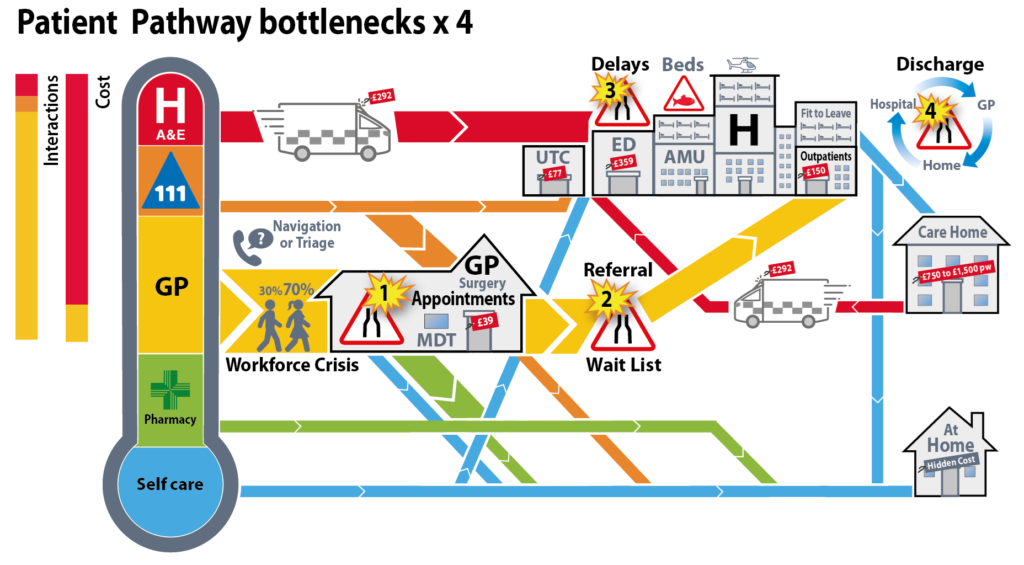
There are 4 main bottlenecks to the patient pathway:
- Not enough GPs in the right place to provide appointments to those most in need.
- Persistent delays in referral to treatment ‘RTT’ – the hospital outpatient wait list.
- Overstretched emergency departments ‘ED’ as less urgent patients present.
- Delayed transfer of care ‘DTOC’ or hospital discharge into the community increasing demand for hospital beds beyond original design capacity.
Tonsmor Doctors has a number of ideas and solutions, some of which have been tested in practice with evidence therefore available as to how they work when deployed – see Blueprint for the NHS
If you have your own ideas or solutions that you would like to share then please do make contact